In one of the most dramatic wildlife rescues in recent Kenyan history, Vetinwild's Dr. Stephen Chege joined a multi-agency team to save eight critically endangered Rothschild's giraffes from a rapidly flooding island in Lake Baringo.
The Crisis
Lake Baringo, located in Kenya's Rift Valley, has experienced dramatic water level increases in recent years due to changing rainfall patterns and watershed degradation. What was once a peninsula became an island, and the island was rapidly shrinking as waters continued to rise.
Eight Rothschild's giraffes (Giraffa camelopardalis rothschildi) found themselves trapped on this shrinking landmass. With fewer than 2,500 Rothschild's giraffes remaining in the wild, losing these eight individuals would represent a significant blow to the subspecies' precarious conservation status.
The Challenge
Rescuing giraffes from an island presents extraordinary logistical challenges:
- Giraffes' extreme height (up to 5.5 meters) and weight (up to 1,200 kg)
- Their powerful kick, capable of killing a lion
- High stress susceptibility leading to capture myopathy - a potentially fatal condition
- Need for specialized transport vessels and equipment
- Rough water conditions on Lake Baringo
The Rescue Team
The operation required unprecedented collaboration:
- Kenya Wildlife Service - Overall coordination and wildlife authorities
- Save Giraffes Now - Funding and project management
- Northern Rangelands Trust - Community engagement and logistics
- Ruko Conservancy - Receiving site preparation
- Vetinwild - Veterinary support and health monitoring
- Local community members - Security, boat operators, and ground support
Custom Solution: The Giraffe Barge
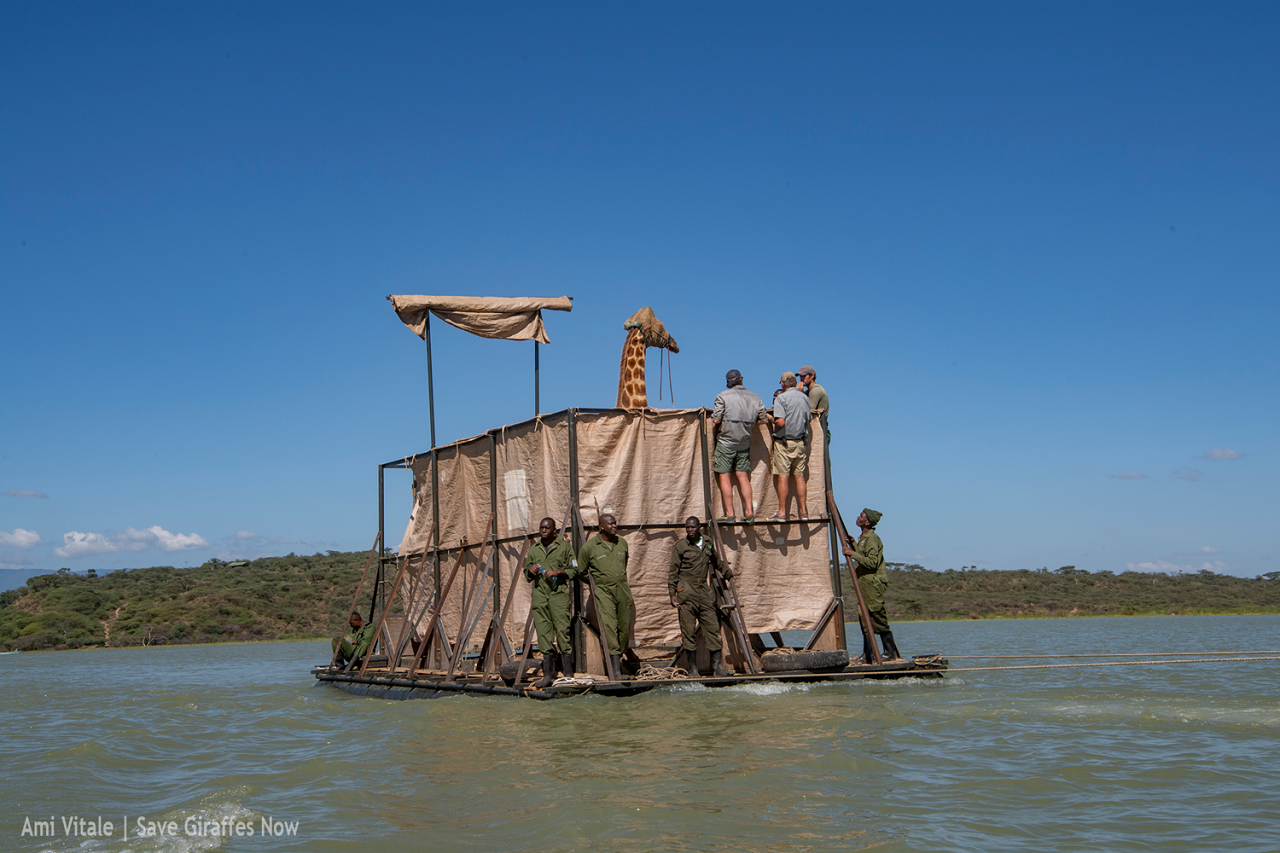
A special barge was designed and constructed specifically for this rescue. The vessel featured:
- Reinforced steel structure capable of supporting giraffe weight
- High-sided containment area (4 meters tall)
- Padded interior walls to prevent injury
- Non-slip flooring
- Access points for veterinary monitoring during transport
The Rescue Process
Phase 1: Habituation (2 weeks)
Before any capture attempts, the team spent two weeks habituating the giraffes to human presence and the barge. Food rewards were used to encourage giraffes to approach and eventually board the stationary barge.
Phase 2: Individual Rescues
Each giraffe rescue followed this protocol:
- Luring: Using acacia browse, giraffes were encouraged to board the barge voluntarily
- Containment: Once aboard, specially designed gates were closed, securing the giraffe
- Veterinary Check: Dr. Chege conducted a rapid health assessment, monitoring heart rate, respiration, and stress indicators
- Transport: The barge was towed across the lake (approximately 1.5 km) at slow speed to minimize stress
- Release: On the mainland, giraffes were released into a temporary boma for observation before final release
Veterinary Considerations
Dr. Chege's role focused on minimizing the risk of capture myopathy - a stress-induced condition that causes muscle breakdown and can be fatal. Key interventions included:
- Continuous monitoring of respiratory rate and pattern
- Assessment of mucous membrane color (indicator of stress and circulation)
- Vitamin E and selenium supplementation to protect against muscle damage
- Immediate administration of long-acting tranquilizers if extreme stress was observed
- Post-release monitoring for signs of delayed-onset capture myopathy
The Results
Over a period of three weeks, all eight giraffes were successfully rescued:
- Pasaka - Adult female, rescued January 15
- Kangare - Sub-adult male, rescued January 18
- Noelle - Adult female, rescued January 22
- Lbarnoti - Adult female, rescued January 25
- Awala - Sub-adult female, rescued January 28
- Asiwa - Sub-adult female, rescued February 1
- Amira - Adult female, rescued February 4
- Martin - Adult male, rescued February 7
Remarkably, all eight giraffes survived the rescue operation with no serious injuries or complications. Post-release monitoring showed normal feeding behavior, social interactions, and movement patterns.
Long-term Monitoring
Following their rescue, the giraffes were released into Ruko Community Conservancy on the eastern shore of Lake Baringo. The conservancy provides:
- Suitable habitat with abundant browse
- Community-based protection from poaching
- Veterinary monitoring through partnership with Vetinwild
- Tourism potential that benefits local communities
Eighteen months post-rescue, all eight giraffes remain healthy and have integrated well into their new environment. Two females have given birth, marking successful reproduction and adaptation.
Conservation Significance
This rescue operation represents more than saving eight individual animals. It demonstrates:
- The possibility of high-risk wildlife rescues with proper planning and expertise
- The power of multi-agency collaboration in conservation
- Community willingness to support wildlife conservation when properly engaged
- The importance of innovative solutions to unique conservation challenges
The rescued giraffes now form a viable breeding population that contributes to the genetic diversity and long-term survival of Rothschild's giraffes.
Lessons for Future Rescues
The Baringo giraffe rescue provided valuable lessons:
- Early Intervention: Monitoring environmental changes enables proactive rather than crisis-driven responses
- Habituation Works: Investing time in conditioning animals to human presence and equipment pays dividends in reduced stress during actual operations
- Specialized Equipment: Custom-designed equipment, while expensive, dramatically improves safety and success rates
- Veterinary Oversight: Continuous medical monitoring enables early detection and intervention for stress-related complications
- Community Engagement: Local community support is essential for both the operation itself and long-term protection of rescued animals
Climate Change Context
The Baringo giraffe rescue highlights the growing impact of climate change on wildlife populations. Changing rainfall patterns, rising lake levels, and habitat transformation are creating novel conservation challenges that will require innovative solutions.
Vetinwild remains committed to developing the expertise and partnerships needed to respond to these emerging challenges, ensuring that Kenya's irreplaceable wildlife heritage is preserved for future generations.
"The successful rescue of these eight giraffes demonstrates what's possible when conservation organizations, government agencies, and local communities work together toward a common goal. It's a model we must replicate as climate change creates new wildlife conservation challenges." - Dr. Stephen Chege, Vetinwild